


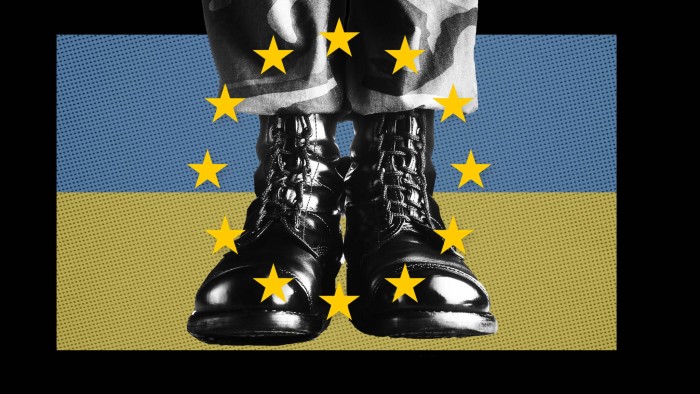
It is an open secret that western special forces are present in Ukraine as “sneakers on the ground”. So far, though, there is no mass deployment of western “boots on the ground”. That may be about to change.
Donald Trump’s return to the White House reignited interest in the idea, first floated a year ago by French President Emmanuel Macron. At the time, it was ruled out as impracticable and too risky. But since then, Ukraine’s military has struggled. The prospect of Nato membership has dwindled. Trump, seeking to disengage the US from European security, has said he wants a ceasefire “as soon as possible”. And Kyiv has hinted at its readiness for a deal, as long as its allies provide strong security guarantees.
As a result, on-off talks have resumed about how western troops, specifically European forces, could help sustain the ceasefire that Trump hopes to broker with Moscow. Volodymyr Zelenskyy has said that if Europe is serious about providing an effective deterrent, 200,000 troops will be needed, at a “minimum”.
How realistic is Zelenskyy’s figure?
Not at all. That is far more than the number of troops that took part in the D-Day landings of the second world war.
Ukrainian officials believe that between 40,000 and 50,000 foreign troops operating as a security force across the 1,000km frontline could be feasible, according to people involved in the discussions between Kyiv and its western partners.
Talks are, meanwhile, under way among European allies, with British Prime Minister Sir Keir Starmer and Nato secretary-general Mark Rutte expected to discuss the issue at an “informal retreat” hosted by the EU on February 3.
So far, only the Baltic states have signalled support for the idea, as long as it is a broader mission with other allies. Poland has ruled out sending troops and insists that it should not be Nato’s border states with Russia that are involved with troops on the ground in Ukraine.
Germany’s outgoing chancellor Olaf Scholz was fiercely opposed to the deployment of German troops in Ukraine. Friedrich Merz, the Christian-Democratic leader likely to become chancellor after elections on February 23, has expressed support for Ukraine, but has not explicitly endorsed the idea of deploying troops.
What would be the goal of putting troops on the ground?
When Macron floated the possibility last February, the idea was that European troops could take on important support roles — such as defending critical infrastructure, training Ukrainian forces, repairing weaponry, or patrolling the Belarus border. This would allow more of Kyiv’s 800,000-strong army to focus on frontline operations, where fewer than half are currently deployed.
However, Trump’s re-election changed the discussion. Now the focus is on how European troops might be used as a peacekeeping force, while helping to sustain Ukraine’s military.
The mission would have three aims: to reassure Ukraine it has western support; deter Russia from attacking again; and show the US that Europe is committed to guaranteeing Ukraine’s security. As Zelenskyy said at the World Economic Forum in Davos, if Europe failed to act decisively, the continent could slide into irrelevance. It was “not even clear”, Zelenskyy said, that Europeans would have a role in any peace negotiations.
For cash-strapped European states, deploying troops may be a more feasible alternative to indefinitely providing Ukraine with billions of euros in military aid.

What might the deployment look like?
The force would have to be “robust enough to not be a soft target that Russia could immediately test, and big enough so that it does not require immediate reinforcement and is not seen as a backdoor commitment by Nato”, said Camille Grand, a former senior Nato official now at the European Council on Foreign Relations.
Such a force could total 40,000 troops, Grand estimated, and would probably be formed under an ad-hoc coalition led by the UK, France and the Netherlands, plus contributions from the Baltic and Nordic countries.
Nato’s role would be deliberately kept to a minimum to limit the risk of escalation with Russia. Even so, Grand suggested that under the “Berlin-plus format”, the EU could use Nato’s strategic planning capabilities for peacekeeping operations, as in Bosnia and Herzegovina. It also allows for UK participation.
Is there a precedent for such a peacekeeping force?
Yes — although this would not be a traditional peacekeeping operation like the UN’s Blue Helmets, which monitor ceasefires, count shells fired and other infractions, but are not authorised to use lethal force and have to remain neutral.
The European troops would obviously be on Ukraine’s side. However, they would not fight on the frontline. As such, they would form a “stabilisation force” or a “deterrence force” rather than a fully neutral “peacekeeping” force.
One model is South Korea, which has a sizeable US military presence although South Korean troops do the fighting. Another is KFOR, the Nato-led “peace support operation” in Kosovo.
KFOR has sustained multiple casualties from the Serbian side since it was deployed in 1999. But that has not meant Nato was “at war” with Serbia. A similar logic could hold with the stabilisation force in Ukraine should it face a Russian attack.

Will it ever happen?
Possibly not. The very notion is premised on there being a decent peace settlement with Russia that allows Ukraine to maintain sovereignty, control its territory, retain its army and remain a democracy that the west is happy to work with.
Russia may never agree to that. Moscow might also break any deal it does sign, as it did when it invaded Ukraine in 2022, in breach of the Minsk agreements it signed after annexing Crimea in 2014 and 2015.
European allies often say their ultimate goal is to build a “stronger Ukraine”, which, according to one western official, would be “able to continue imposing heavy costs on Russia, stop Russian troop advances, and . . . sustain that for as long as necessary in terms of material, manpower and finance”.
But Europe may balk at sending troops into a “hot war” for fear of escalating the conflict with Russia. Even if European leaders do decide to send troops, their parliaments and voters may disagree. The US may also refuse to provide the logistical support that the operation would need.
Still, the risks of sending in troops may pale in comparison with those of inaction. As Starmer said during his recent visit to Kyiv: “This isn’t just about Ukraine’s sovereignty. If Russia succeeds in its aggression, it will affect us all for a very long time.”
Additional reporting by Christopher Miller in Kyiv
Read the full article here

