


Receive free Automobiles updates
We’ll send you a myFT Daily Digest email rounding up the latest Automobiles news every morning.
This week, Toyota shares continued their cruise towards an all-time high, building on a rise of almost 30 per cent since the start of the year and blown by a following wind, according to Refinitiv data, of 17 “buy” recommendations from analysts.
Improbable stuff, perhaps, for a century-old leviathan whose 2022 sales of pure battery electric vehicles were just 1.8 per cent those of Tesla and whose almighty global bestseller — the Corolla — was outsold by Elon Musk’s Model Y in the first quarter of 2023.
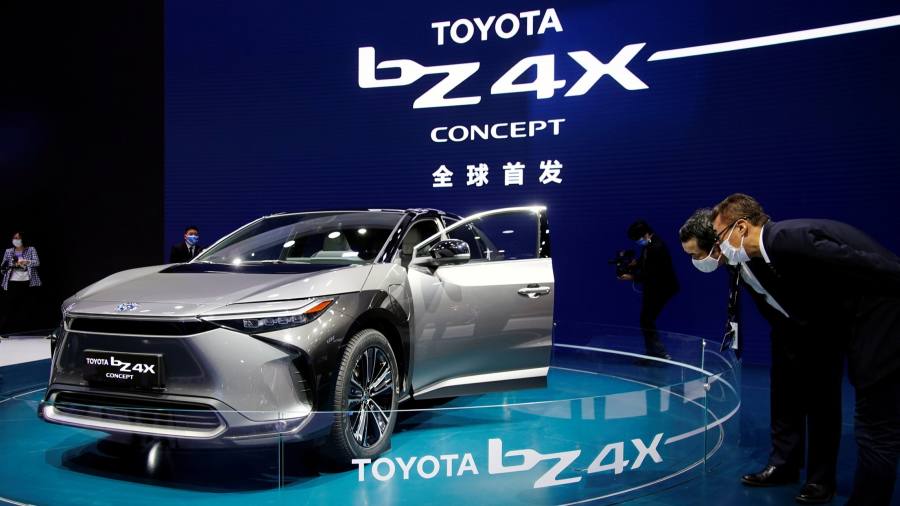
The Japanese company has been accused of entering the global EV race grudgingly and at half-throttle. Its flagship EV offering — the bZ4X — was burdened with a door-entry code of a name and recalled shortly after its launch over actual concerns that the wheels could fall off.
The factor that helps explain the share price-versus-setback paradox are the words “solid state” — the elusive, game-changing technology that could in theory allow for much lighter, quicker-charging and more powerful batteries and in which Toyota said last month it had made a breakthrough.
With various caveats, earlier durability issues had been solved, Toyota said, and, while acknowledging the stiff challenge, the company should be able to mass produce, commercialise and mount a solid-state battery in a vehicle as early as 2027. Success is not guaranteed, though. Toyota, whose chief technology officer said the company did not see solid-state batteries as the ultimate solution, sounds far from psychologically committed to the technology.
But markets often ignore those details: for many investors, the possibility that Toyota might have pulled ahead of rivals in one of the great tech races of the era raises some awkward questions for those who had written off Japan’s powers of reinvention in general, and Toyota’s in particular. Who, after all, would want to miss out on the possibility that Japan’s most valuable company is in sight of a battery able to propel a car 1,200km on a 10 minute charge?
But CLSA autos analyst Christopher Richter argues this is only part of the renewed glow around Toyota. Along with the eye-catching solid-state zinger, Toyota has provided timeframes for four other battery technologies to be rolled out.
Some have sensed desperation. The message intended to accompany the tech announcements was two-fold: first, that Toyota is now genuinely serious about EVs and second, that in a world where many EV-makers are reliant on others to develop and commoditise batteries, Toyota’s magic differentiator is that it can do it in-house. The tyres on both of these messages need a decent kick. Long-term faith in Toyota requires a good deal more than believing its capacity for technological breakthrough.
The difficulty lies in framing the issue in a way that fairly measures achievement against ambition. Toyota, by production and sales, is the world’s number one automaker. But rapidly changing times and the progress of Tesla — and even, arguably, of China’s BYD — have made Toyota feel some way from the global top slot in terms of importance and leadership.
The psychological blows to the company have been heavy. For decades, it has prevailed in a combustion-engine industry where newcomers were few and the advantages of its position of incumbency large. Toyota could surely see that the world was shifting towards EVs and that the market wanted it to follow, but had a visceral aversion to competing in a realm where the barriers to new entrants are relatively low.
Now that Toyota has made it clear that it intends to compete on EVs, it clearly deserves re-evaluation — not least because a company as deep-pocketed and resilient as Toyota is at its best in crisis mode. But rather than solid-state batteries, the focus should be on three questions.
The first is whether the declared cultural change at the top of Toyota can be quickly and thoroughly transmitted down through the company. The second is whether it actually needs to be: kaizen — the Toyota-perfected process of continuous small improvements — got the company this far. It may not be the right formula at this moment of huge disruption but who is to say the magic will not return once EVs are the dominant life form?
The third question is whether the meteoric rise of more streamlined players like Tesla has blinded markets to the long-term importance of Toyota’s global complexity and range of offering. The shift to EVs may have flattered the Tesla proposition that a small handful of models and a cars-are-just-iPhones-on-wheels attitude is right: in 10 years, the market may decide otherwise.
Read the full article here

