


Unlock the Editor’s Digest for free
Roula Khalaf, Editor of the FT, selects her favourite stories in this weekly newsletter.
Is anyone prepared to step up and take on part of the huge costs of ensuring the US has a position at the forefront of the world’s most advanced manufacturing industry?
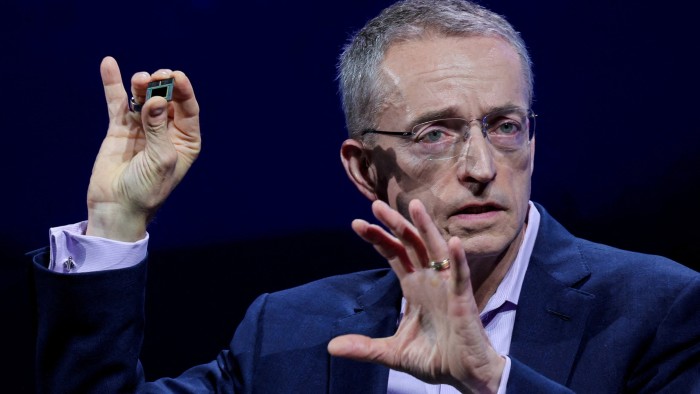
That question looms large at the end of a week of turmoil at Intel, the world’s leading chipmaker for decades until its recent struggles. The abrupt departure of chief executive Pat Gelsinger is the clearest sign yet that the company’s board is having second thoughts about the trajectory of its ambitious, $100bn investment plan.
Gelsinger had smartly staked an explicit claim to national champion status for Intel, aware that his company’s expensive attempt to reclaim a lead in advanced chip manufacturing would require all the support from Washington it could get. But he also needed to pull off a corporate turnaround of breathtaking difficulty. Given the huge capital investment and the long process and product cycles involved, this has been a painful, slow-motion slog in the full glare of Wall Street.
The obvious conclusion from this week’s events is that Intel’s board is losing its appetite to underwrite the effort to make the US a power in advanced chipmaking, even with the billions of dollars of taxpayer support it formally secured last week under the Biden administration’s Chips Act.
There has been no admission of a strategy shift, but the implications of Gelsinger’s departure were not lost on anybody. He was the strongest advocate of a plan that called for Intel to double down on manufacturing, and stood against persistent calls for the company to be broken up into separate manufacturing and chip design operations.
Any shift in emphasis at this point would look like a reversal. The all-or-nothing strategy devised by the former CEO makes it hard to settle for half measures. Trying to become globally competitive in manufacturing has meant committing to building fabs (plants) that operate at huge scale, dwarfing the likely needs Intel will have for chips made to its own designs. So to cover the massive fixed costs, it has had little choice but to become a chip foundry, or contract manufacturer. That has meant trying to persuade some of its arch-rivals to let it make their products, and showing it can go toe-to-toe with TSMC, the specialist manufacturer that dominates the industry.
And it has had to pull all this off while recovering from a decade of manufacturing slips and product misses that included failing to anticipate the smartphone and AI booms. In essence, the Gelsinger plan was to rebuild the old Intel in all its glory and then, for good measure, create a world-class manufacturing services business on top.
His departure makes a break-up seem more likely. But that would still leave the new companies tied at the hip, since the product arm would need to commit to buying chips from the manufacturing arm to keep it afloat in the many years it would take to build an independent foundry business.
If Intel’s board decides not to carry on down the challenging financial path set by Gelsinger, then is anyone else prepared to step up? That could come from backing Intel in its current form or, perhaps more likely given the company’s struggles, supporting a standalone chip manufacturing arm.
Washington may need to get involved if advanced chipmaking is essential to future national competitiveness. Finding the political will for something that would inevitably be seen as a bail out for Silicon Valley looks like a tall order, but the debate is starting to look unavoidable. The other group with an interest in advanced US chip manufacturing are the potential customers. Companies including Nvidia, Qualcomm and AMD — as well as giants such as Apple, Google and Amazon that now design their own chips — all rely on TSMC and, to a lesser extent, Samsung for their manufacturing.
Those companies could benefit from an alternative that acted as a commercial counterweight to TSMC, as well as a domestic supplier freed of geopolitical risk. Right now, though, the industry operates perfectly well without an Intel foundry business, and lining up to stand behind the company in its current form looks unlikely.
As long as Intel’s direction is in doubt, it is hard to see where more external support might come from. Its board needs to show it can regain control of the situation — something it took one step towards on Thursday, when it named two much-needed chip industry veterans as directors. But finding a new CEO with the willingness and ability to keep leading it down a path that has just buried the career of one well-regarded executive will be a tall order.
Read the full article here

