


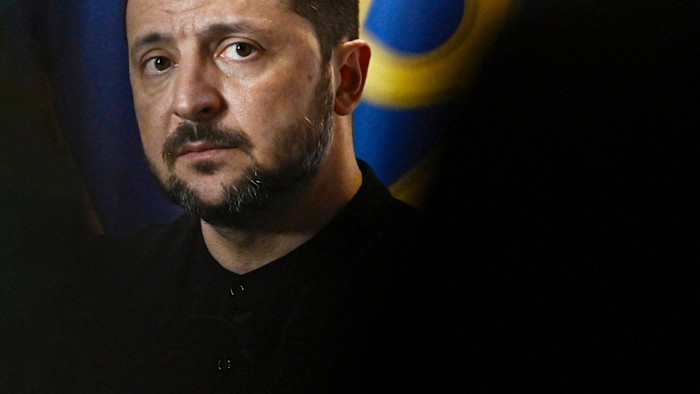
Ukraine has begun planning presidential elections alongside a referendum on any peace deal with Russia, after the Trump administration pressed Kyiv to hold both votes by May 15 or risk losing proposed US security guarantees.
The move, according to Ukrainian and western officials and others familiar with the matter, comes amid intense pressure on Kyiv by the White House to wrap up peace negotiations between Ukraine and Russia in the spring.
The plan aligns with a US push, outlined by Volodymyr Zelenskyy to reporters last Friday, to have all documents signed to bring Europe’s largest conflict since the second world war to an end by June.
“They say that they want to do everything by June . . . so that the war ends,” Ukraine’s president told reporters, citing the White House’s desire to shift its focus to the US midterm elections in November. “And they want a clear schedule.”
Holding an election would mark a dramatic political pivot for a president who has repeatedly argued that such votes are impossible while the country remains under martial law, millions of Ukrainians are displaced and about 20 per cent of the country is under Russian occupation.
According to Ukrainian and European officials involved in the planning as well as others briefed on the matter, Zelenskyy intends to announce the plan for presidential elections and a referendum on February 24, the fourth anniversary of Russia’s full-scale invasion.
“The Ukrainians have this hard idea that it all needs to be bundled with Zelenskyy’s re-election,” said one western official familiar with the matter.
Zelenskyy’s office did not respond to a request for comment. The US embassy in Kyiv declined to comment.
Ukrainian and western officials stressed that both the timetable and the US ultimatum were unlikely to hold, as they hinged on several factors, including that progress could be made towards a peace deal with Russian President Vladimir Putin.
But the plan underscores Zelenskyy’s desire to maximise his re-election prospects while reassuring US President Donald Trump that Kyiv is not slow-walking a peace deal if one can be reached.

Public support for Zelenskyy, while still substantial, has declined from the near-unanimous levels four years ago, national polling shows, amid fatigue with the war and corruption scandals within the president’s inner circle.
People close to Zelenskyy said he and his team had signalled to the Trump administration that they were open to the extraordinarily swift timeline, despite the logistical hurdles of holding an election at short notice in wartime.
Zelenskyy has said that Ukraine and the US have reached an agreement on security guarantees and is ready to sign them with Trump.
But the US president has indicated to Kyiv that American security guarantees are contingent on agreeing the broader peace deal that would probably involve ceding the Donbas region to Russia, and which Washington wants done before the May 15 deadline.
Zelenskyy has so far resisted calls for conceding territory, saying last week that Ukraine will “stand where we stand”.
The officials cautioned that the Trump administration has previously set deadlines that have passed, but Washington is giving Kyiv very little room for manoeuvre as the US midterm elections loom.
They said the plan could also be delayed because of how far apart Kyiv and Moscow remain on the key issue of territory, including control over the Donbas region and the Zaporizhzhia nuclear power plant.
The timeline may also be disrupted if Russia escalates its attacks on Ukraine’s critical infrastructure and ground offensive in the south-east, where its forces are grinding forward but taking enormous casualties, they said.
Putin has insisted that he will continue to pursue his maximalist goals including seizing the Donbas through force if Kyiv and the west do not heed his demands, despite Trump and his special envoy Steve Witkoff saying they believe the Russian leader is ready to make a deal.
The election plan may hinge on whether Zelenskyy can secure a peace deal that he believes is fair and tolerable to Ukrainians, the officials said. The Ukrainian president has long sought to put any peace deal to a national vote to ensure its legitimacy.

Under the working timeline, Ukraine’s parliament would spend March and April working through the legal changes required to enable voting under wartime conditions. Martial law prohibits Ukraine from holding national elections during wartime.
Experts caution that the expedited timeline would mean elections are held while hundreds of thousands of troops are deployed to the front line and millions of Ukrainians are displaced, posing risks to the legitimacy of the vote.
“Six months’ preparation for elections is not the maximum [amount of time needed], it’s the minimum,” said Olha Aivazovska, chair of the board at OPORA, a Kyiv-based think-tank that advises authorities on democratic governance, electoral legislation and parliamentary reform.
Crucially, without a ceasefire, Aivazovska said, it could be easy for Russia to disrupt the vote. For example, the omnipresence of Russian drones “puts polling stations across Ukraine under threat”, she said.
“There has never been a situation like this. It’s completely unprecedented,” she added.

Many politicians are also against holding elections before a lasting peace deal backed by strong security guarantees is achieved, because such a move is likely to exacerbate domestic political divisions.
“Political competition during the war is bad,” Kyiv mayor Vitali Klitschko told the FT. “We can destroy the country from inside . . . [which is] Russia’s goal.”
But people close to the president said he believed his best chance at re-election in Ukraine, which has traditionally not favoured incumbents, is this year and perhaps more so if the vote coincides with a referendum.
Officials and election experts added that by holding both ballots at the same time, Zelenskyy would also be likely to ensure a larger turnout.
The western official said Ukraine needed at least half of those registered to vote before the war to participate to ensure the result would be recognised by international monitors and not give anyone — particularly Russia — a reason to claim the results as invalid.
“If we do this wrong . . . if we rush this, we will do huge damage to the quality and future integrity of our democratic process,” Aivazovska said. “And it will be seen as illegitimate.”
Cartography by Cleve Jones
Read the full article here

