


Unlock the Editor’s Digest for free
Roula Khalaf, Editor of the FT, selects her favourite stories in this weekly newsletter.
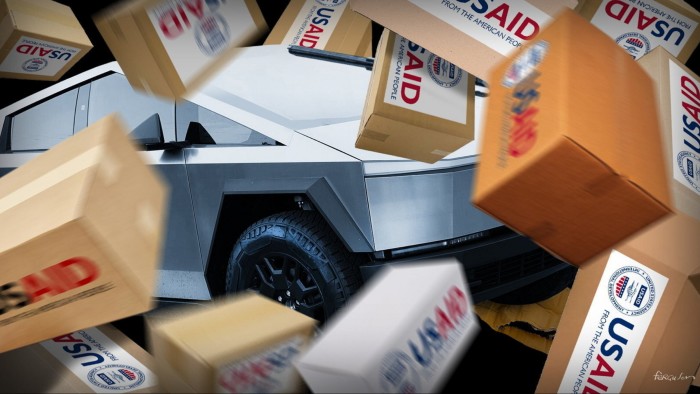
It is disgusting to read the boast of the world’s richest man that “we spent the weekend feeding USAID into the wood chipper”. That this raises constitutional and legal issues for the US republic is quite clear. Indeed, it is evident that those now in charge would be quite happy to dispose of such tiresome constraints altogether. But there are also moral issues. Should the US effort to succour the world’s poorest have been fed into a “woodchipper” at all? The answer is “no”.
As Paul Krugman notes in an exceptional recent piece on his Substack, the US made a huge effort after the second world war to be a new and different sort of great power: it sought to create allies, not tributaries; economic development, not predation; global institutions, not imperial rule; and international law, not the old idea of “might makes right”. There was, inevitably, much backsliding. But in all, the US has indeed been a strikingly benign and successful hegemon.
The explosive growth of world trade, the rise of once-impoverished China and India, the peaceful fall of the Soviet Union and, not least, the decline in the proportion of human beings living in extreme poverty — from 59 per cent in 1950 to 8.5 per cent in 2024, despite a tripling of the world population — are proof of its success. The US should be hugely proud of its achievements as world leader, and not seek to imitate the bullying of Vladimir Putin’s Russia, instead. (See charts.)
The US Agency for International Development, then, is part of something far bigger. The US also played a decisive role in the creation of the World Bank, the IMF, the UN, the General Agreement on Tariffs and Trade, the International Development Association and Nato — unambiguously, both then and now, a defensive alliance.
The underlying idea was that the world would be a better place if we recognised our shared interest in peaceful co-operation. Why would anyone wish to sacrifice this ideal for a return to the 19th-century competition among imperialist great powers that culminated in two world wars, Stalinism and fascism? Do pathogens or the climate recognise international borders? Is war among nuclear powers even thinkable? Can any country truly be an island? Can humanity, having trashed this planet, really find rescue on the barren planet of Mars?

The onslaught on USAID is a token of the madness now overwhelming the US. But it is revealing. Its budget was 0.7 per cent of federal spending and 0.15 per cent of GDP in the 2023 fiscal year. Its destruction is above all symbolic. According to Musk, USAID is a “viper’s nest of radical-left marxists who hate America”. USAID spends on things like Aids relief and family planning in the world’s poorest countries. So, what radical-left Marxist launched the President’s Emergency Plan for Aids Relief? George W Bush, that’s who. Even if this onslaught proves just an interruption, it will do much damage.

Unfortunately, this comes at a bad time for economic development. As the World Bank’s latest Global Economic Prospects notes, not only is global economic growth slowing, but the performance of low-income developing countries has become particularly worrying.
“Catch-up toward advanced economy income levels has steadily weakened across [emerging market and developing economies] over the first quarter of the 21st century,” the report argues. This is the result of successive shocks, slowing reforms and a more adverse external environment, characterised in large part by “heightened policy uncertainty and adverse trade policy shifts”.

“Rapid growth underpinned by domestic reforms and a benign global environment allowed many low-income countries . . . to attain middle-income rank in the first decade of this century. Since then, the rate at which low-income countries are graduating to middle-income status has slowed markedly.” Growth in real incomes per head in these countries has simply become anaemic. That is partly because of internal conflict and partly because of adverse external developments, including the global financial crisis, the pandemic, unexpected jumps in prices of essential commodities and higher interest rates.

As a result, argues the report, across a wide array of development metrics, today’s low-income countries are behind where the ones that subsequently became middle-income were in 2000. They are also now more susceptible to shocks related to climate change.
In considering the plight of the poorest countries it is necessary to understand the constraints upon them. They lack the resources to provide healthcare or needed education. Thus, according to the World Bank, spending on health per person in high-income countries is more than 50 times as big as it is in low-income ones, in real terms, and spending on education is more than 150 times as big. Moreover, the cost of interest on debt has climbed to more than 10 per cent of government revenues in low-income countries, partly because of the need to borrow in crises and partly because of the elevated interest rates.

A world with more prosperous, healthier and more stable countries is a better one to live in, not just morally, but practically. The main instruments for achieving these ends remain multilateral institutions. If the US is going to turn away from its past wisdom, it is up to the rest of us to create a multilateral way forward, while hoping that the US will at last find a way back into the light.
Minouche Shafik has argued persuasively for some serious rethinking. There are indeed many global challenges ahead, as she notes. But there is one glorious opportunity. Eliminating the scourge of extreme poverty from our planet is now tantalisingly near. But we are failing. We must try harder. This long-sought goal is far too close to be abandoned.
Follow Martin Wolf with myFT and on X
Read the full article here

