


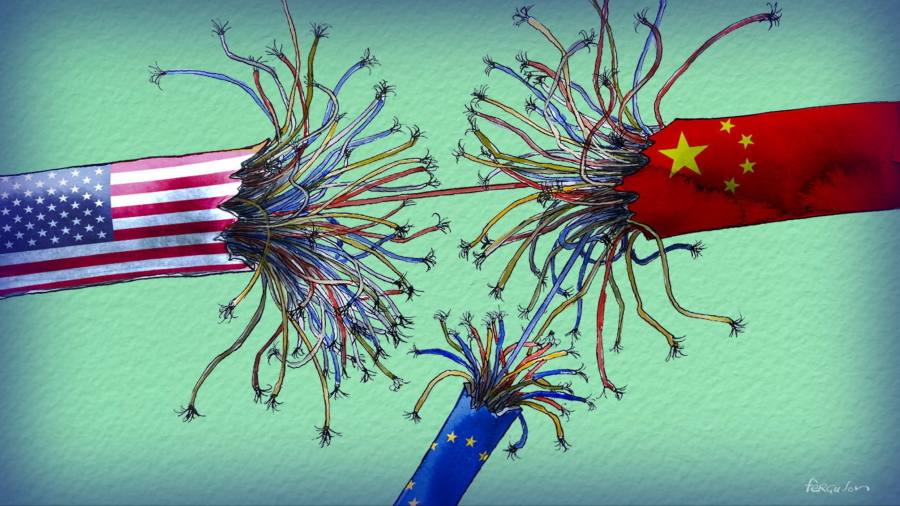
The contest for word of the year is already over. In the geopolitical category, the winner is “de-risking”.
This D-word has moved from obscurity to ubiquity in less than two months. It was the centrepiece of a speech about China made in late March by Ursula von der Leyen, the European Commission president. De-risking was then seized upon by the Biden administration. Then, last week, it was endorsed by a G7 summit.
One reason why western leaders have embraced de-risking with such alacrity is that it gets them off a rhetorical hook. Previous talk of “decoupling” western economies from China was often castigated as impossible and extreme. De-risking sounds more prudent and targeted. Western businesses are being told that they can still trade with China — it is just that some safeguards are needed.
The kind of risks that the US and the EU are worried about can be put into two broad categories: stuff the west gets from China; and stuff that China gets from the west.
In the category of “stuff they get from us”, advanced technology with potential military uses is at the top of the list. The restrictions on semiconductor exports announced by the US and — last week, by Japan — fall into this category.
At the same time as the G7 nations are restricting China’s access to critical technologies, they are also trying to free themselves from what they regard as dangerous dependencies on China. The rare earths and critical minerals that are crucial for battery technology and the green transition are top of the list. As von der Leyen noted in her speech, the EU imports 97 per cent of its lithium — crucial in the production of batteries — from China.
Another dependency that the west is striving to reduce is the more than 90 per cent of advanced semiconductors that come from Taiwan, the island which is vulnerable to an invasion by China. The US Chips Act of 2022 provided $52bn of funding to boost the manufacturing of chips in the US.
The theory behind de-risking is now reasonably clear. The practice, however, is much murkier.
Three big difficulties are already emerging. First, the clash between the interests of companies and countries. Second, the difficulty and expense of lessening dependencies on China. Third, a lingering ambiguity about the nature of the risk. Are we concerned about political coercion by China, or are we really worrying about a war?
In normal times, supporting domestic companies that want to export is a key goal of western governments. But that is no longer always the case, in the world of de-risking.
Last week Jensen Huang, CEO of Nvidia, the California-based semiconductor group, warned of “enormous damage” to American companies if they are prevented from selling advanced chips to China. But US officials are unrepentant. They point out that Nvidia chips are crucial to the development of AI.
They also say that China could easily use advanced AI for all sorts of nefarious purposes, from the production of bio-weapons (a particular Chinese interest, apparently) to political manipulation through “deep fake” news. The further tightening of restrictions on outbound investment to China, by both the EU and the US, will mean that more western companies experience Nvidia-style controls in future.
But the restriction of exports and critical technologies is obviously a game that two can play at. So the west is also urgently trying to reduce its dependencies on China in crucial areas.
Opinions differ on how easy this will be. Liesje Schreinemacher, the Dutch trade minister, warned this week that Europe’s green transition will be impossible without China, which is by far the largest global producer of solar panels, batteries and the critical minerals that go into them. One western intelligence official contends: “It’s taken 30 years to build up our dependency on China for critical minerals and rare earths, and it will take the same amount of time to unwind it.”
But Jason Matheny, president of the Rand Corporation, who worked on technology and national security in Joe Biden’s White House, is more optimistic. He points out that “rare earths are actually not that rare”. China’s real lock is on the processing of critical minerals, which is often a very dirty business. But some countries with a relatively low population density, such as Australia, seem prepared to take that on.
The emerging western approach to de-risking rests on three broad pillars: reduce dependencies on China, restrict technology exports, but also continue to encourage western companies to trade with the vast Chinese market. It is a more or less coherent policy, as long as the risk that is being hedged against is political coercion. But it begins to fall apart if the risk is an actual war between the US and China, perhaps over Taiwan. Unnervingly, some US officials now put the chance of a military conflict at 50 per cent or more.
If that happens, then western companies will come under immediate pressure to pull out of China. For a firm like Apple, whose products are mainly produced in southern China, or Volkswagen, which makes at least half its profits in China, that might spell corporate death. On the other hand, as one western security official puts it: “If there is a war with China, the impact on the world car market will be the least of our problems.”
Read the full article here

