


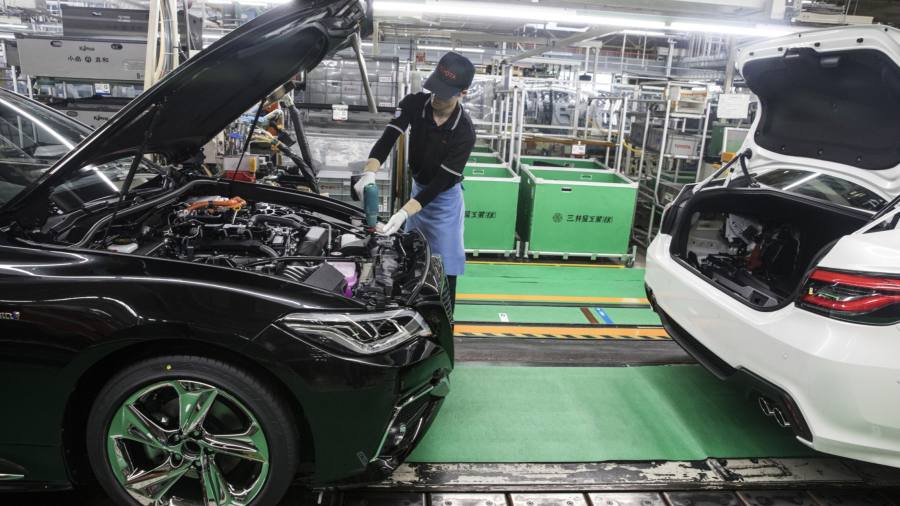
In a rare admission for the world’s largest carmaker and Japan’s most powerful company, Toyota’s chief executive Koji Sato admitted last week that there were “limitations” to its ability to provide support to its truck subsidiary Hino Motors.
On the same stage in Tokyo, Martin Daum, the head of Daimler Truck, issued a similarly grim warning that the merger of the two groups’ truck units in Japan was essential for survival in the race for carbon neutrality.
“We have to change a system that was successful over the last 120 years within the next 10 years to a completely new system,” Daum said, noting that the effort would require new infrastructure for energy generation and distribution. “We have to do it to save the planet. This is so massive that you can’t do it alone.”
Consolidation within the country’s crowded automotive industry was long overdue. But Toyota’s decision to offload its commercial truck unit — scarred by repeated emissions and fuel efficiency scandals — comes as the company faces pressure from shareholders to improve its governance structure and climate policy.
Two of the largest US public pension systems — the California Public Employees’ Retirement System and the Office of the New York City Comptroller — have voted against the re-election of Akio Toyoda at its upcoming annual meeting after proxy adviser Glass Lewis criticised the Toyota chair for presiding over a board that was not sufficiently independent. Along with Institutional Shareholder Services and the Church of England Pensions Board, the US pension plans also backed a shareholder proposal seeking more disclosure on the company’s climate lobbying efforts.
Toyota said it would actively engage with shareholders and consider the most appropriate board structure.
The carmaker has repeatedly been criticised by investors for not being aggressive enough with rolling out electric vehicles and appearing to be overly protective of its hybrid technology. The criticism is not new, but at the heart of the issue is a climate change challenge that goes well beyond the predicament facing Toyota.
One of the biggest risks for businesses is the competitive disadvantage they would face if, despite good intentions, global investors judge that Japan, with its heavy reliance on coal, natural gas and oil, is turning to an environmental policy that is out of step with the rest of the world.
The country has pushed for an energy transition and climate strategy in Asia that does not sacrifice economic growth, saying the situation for developing countries in the region was “unique” compared with advanced economies in the US and Europe. Its push for ammonia as a tool to reduce emissions also recently faced a backlash from other G7 members since it risked prolonging existing fossil fuel infrastructure.
In the corporate world, Panasonic, Hitachi and others have campaigned for a new environmental metric — dubbed “avoided emissions” or Scope 4 — that would quantify contributions companies make towards reducing carbon emissions in the broader society by offering energy-saving products and services. In Panasonic’s case, the company argues that its contributions to lowering emissions by selling car batteries for use in Tesla’s electric vehicles should be recognised, even if producing the batteries is carbon intensive.
While the concept has won backing from asset managers such as London-based Schroders, critics have warned that creating a new climate measure would distract companies from actually reducing their carbon footprints in their own operations and supply chains.
Kim Schumacher, associate professor in sustainable finance at Kyushu University, says Japan’s push for ammonia as well as avoided emissions is fundamentally driven by the need to make Japanese products more competitive, even if they are produced with a bigger carbon footprint than those made in other countries with more decarbonised energy sectors.
At present, companies with manufacturing sites in the country, such as Sony, are struggling to meet demands from Apple and other global clients to reduce the carbon footprint of their domestic supply chains.
The climate challenge also comes at a particularly sensitive geopolitical moment. Global semiconductor companies, including Micron, Samsung Electronics and Taiwan Semiconductor Manufacturing Company, are planning to increase manufacturing and research in Japan in response to the risks posed by the technology war between the US and China.
But if Japan wants to position itself as a reliable and supply chain-friendly partner of the west, it will only create harm if its climate efforts, regardless of their logic, are seen as going against the global tide.
Read the full article here

