


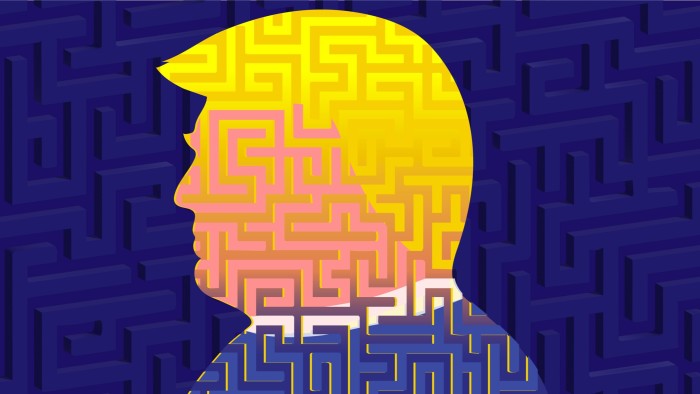
What on earth will happen to US economic policy when Donald Trump becomes president? That question is already sparking widespread concern. And even the supposedly smart money seems unsure of the answer.
This week, for instance, the hedge fund Bridgewater told clients that Trump’s “nominations and rhetoric so far appear to suggest he will try to go big and radically reshape US institutions, global trade, and US foreign policy”. Gulp. But it then went on to stress that this is just “a guess”, since there is “low confidence in the likely programmes now”. In plain English: hedge your bets.
This uncertainty partly reflects Trump’s erratic style and taste for brinkmanship. But it also highlights something else: his recent policy pledges are riddled with contradictions. Investors can only watch to see how these do, or do not, play out.
What are these contradictions? The first revolves around inflation. During his presidential campaign, Trump attacked the Biden administration for the Covid-era price surge, and promised to end inflation. But he is also pledging to impose tariffs of 60 per cent on China and 25 per cent on Mexico and Canada, which could “derail” the inflation fight, as Janet Yellen, US Treasury secretary, warned this week.
Stephen Moore, a Trump adviser, dismisses such talk. “Trump raised tariffs in his first term, but where was the inflation? There wasn’t any,” he recently wrote in his newsletter. Fair point. But this week we learnt that inflation is already 2.7 per cent, above the Federal Reserve’s target and far higher than in 2016. Goldman Sachs projects that tariffs will raise that rate by one percentage point — even before deportations raise labour costs.
Second is the issue of interest rates. This week, Trump pledged to leave Jay Powell in place as Fed chair. But he previously tried to bully the “idiot” Powell into cutting rates. And he has an incentive to try again, given that debt-servicing costs have surged. How this squares with Powell’s defiant declarations of Fed independence is anyone’s guess.
Then there is the dollar. Trump’s team considers it very overvalued. Scott Bessent, Treasury secretary nominee, told the Manhattan Institute this summer that “in the next few years . . . we are going to have to have some kind of a grand global economic reordering, something on the equivalent of a new Bretton Woods”. Indeed, Takatoshi Ito, Japan’s former finance minister, notes that “some observers, including myself, speculate that . . . Bessent might even call for a special G20 meeting” to reproduce “the 1985 Plaza Accord”.
However, Bessent also told the same Manhattan Institute meeting that two-thirds of any tariff impact typically shows up through currency gains — implying that tariffs will strengthen the dollar. Most economists agree. Go figure.
This creates a fourth uncertainty around the trade deficit. Trump’s team tell me they explicitly reject the economic orthodoxy inspired by the 19th-century economist David Ricardo — specifically, the idea that countries export goods to earn money to pay for imports, and if each country specialises in areas of comparative advantage, everyone is better off.
Instead, Trump’s advisers want to slash the deficit by using America’s political and commercial dominance (via tariffs), while also maintaining capital inflows. Doing both may be hard. And any dollar strength could suck in more, not fewer, imports, particularly if growth accelerates.
All this could actually widen the deficit, says Ken Heydon, a former Australian trade official. Indeed, during Trump’s first presidency “the US trade deficit soar[ed] to its highest level since 2008, increasing from US$481bn to US$679bn”, he notes.
A sixth issue is the Brics, or Brazil, Russia, India, China and South Africa. Last month Trump threatened sanctions if these countries challenged the dollar by launching their own common currency. But they have not shown any serious plan to do this. Such threats might backfire. As a blog from the free-market American Enterprise Institute notes, “unlikely as an abandonment of the dollar would be, the capricious, indiscriminate, and unilateral wielding of US power . . . could indeed make that happen”.
Last but not least is the fiscal deficit. Trump vowed to slash it from 6.5 per cent to 3 per cent of GDP. But he also wants huge tax cuts. His team says the gap will be filled by higher growth, government spending cuts and revenues from tariffs. However, “achieving these goals simultaneously will be difficult, if not impossible”, even if small fiscal improvements occur, says Tiffany Wilding, an economist at Pimco.
Maybe Trump will defy the sceptics, and prove economic orthodoxy wrong. Indeed, the markets are already acting as if this were the case — that Trumponomics is set to deliver the holy grail of high growth, low inflation and some budget control. If that comes to pass, I will be thrilled. But in the meantime, those seven contradictions loom large. So if you feel confused about Trump, don’t fret: uncertainty is the most rational response now.
Read the full article here

